Wednesday, July 9, 2008

New video updates on "Shift Happens"

Check out my side column for Karl Fisch and Scott McLeod's Shift Happens.


I came across this video almost a year ago, and I think its focus strongly parallels what I am trying to accomplish in my blog, that is, to make people, especially teachers, seriously think about the future of our world.

-----

Image Citation:

Shift happens. Retrieved July 8, 2008 from http://www.jonathansblog.net/userfiles/shift_happens_web-poster.jpg

Thursday, June 26, 2008

YouTube and Chopin

This week, I tested a couple of new ideas in my English classrooms. First, I should explain that in one of my classes, we read short stories every week, and as many students and English teachers know, reading and discussing short stories can get boring quickly if the teacher does not integrate a unique approach into discussion. Of course, dialogues about themes, symbols, and characterization are exciting to me, but eighth graders for some reason do not have the same internal desire to discuss such things. Okay, I can live with that, but usually, students enjoy watching film adaptations of novels and plays, right? So, where do you find film adaptations of short stories? YouTube! After an effortless search for Kate Chopin’s “The Story of an Hour,” I discovered numerous hits, and I had each student view a different adaptation while taking notes on the director’s interpretation of plot, characterization of Mrs. Mallard, and overall point of view. After watching their video clips, which were more than likely produced by high school or college English students around the world, I let each student share his/her observations and explain why they agreed/disagreed with the director’s production. Anyone up for some critical, reflective conversations? This was an awesome exercise, and I would recommend it to everyone. Now, only if I had enough time for them to create their own rendition of the short story.

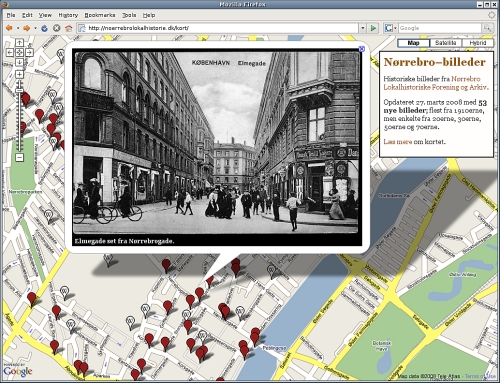
For my younger students, I have been trying to teach research skills, and this week, we maneuvered Google Maps to develop mapping skills – which is somewhat related to research. In our novel for class, the characters travel along the east coast of Denmark hitting three large cities in addition to Copenhagen. With the list of other cities, students had the following mission: locate the four cities on a map, calculate the total distance traveled by train from Copenhagen to the northernmost city, and draw a map of eastern Denmark and southwestern Sweden. (The proximity of Denmark to Sweden plays an integral role later in the novel.) What made the activity interesting was that all of the city names were in Danish (e.g., Copenhagen = Kobenhavn). Overall, it was a fun activity. Students enjoyed using Google Map and found it “cool” that you could add destinations to extend your route. I wonder how they would have responded to Google Earth.

-----

Image Citations:

YouTube. Retrieved on June 26, 2008, from http://www.erikbosgraaf.com/images/youtube-logo.png
Copenhagen. Retrieved on June 26, 2008, from http://noerrebrolokalhistorie.dk/img/histbillederkort01s.jpg

Sunday, June 22, 2008

Experiment with confidence

From reading blogs and instructional technology magazines, I come across quite a few different tools that I can supposedly implement into the classroom to improve instruction. With enough time and resources, I could probably make my classroom into one of the most interactive and rich learning environments around, but time is tough to come by. During the school year, it only takes a few months (if you are lucky ;) ) to fall a little behind schedule, and once behind schedule, you must utilize every extra moment to get students back on track. In the summer, however, teachers generally have a lot more time on their hands. Now, before I hear the cry of tired teachers, “We need a break from school, too,” trust me, I understand. Occasionally, though, over the next two-and-a-half months, experiment a little with various Web 2.0 tools. If you practice during the summer months, you may prevent many mistakes in the fall.

Last Thursday, for example, I used Audacity for the first time. First, the students wrote a 1 – 1 1/2 page response to one of two prompts. Second, they recorded their written responses using Audacity. After exporting the sound files as .WAV files, I easily inserted them into our Wikispaces classroom website. Once the two students were finished, each student listened to the other student’s recording and responded to the recording with a one-paragraph response. The exchanges were incredible! With a primary focus on a couple of character relationships from the short story we read in class, students generated original analysis of characterization by creating hypothetical verbal exchanges between characters. Overall, students found the experience enjoyable, and I look forward to experimenting with other tools over the course of the next few weeks.

On a slightly different note, I want to share an observation. The other day, I had fourth grade students perform some research on the Danish Resistance and the role between Denmark and Sweden in 1943 in preparation of our reading Lois Lowry’s Number the Stars. I gave one group the former topic and other group the latter. After about 20 seconds, the second group began complaining that they could not find anything about their topic. When I asked them to show me how they researched, they demonstrated how they attempted to use Wikipedia and Google, but nothing was coming up. After encouraging them to use different resources and to search various key terms, they eventually found appropriate information. I was a little surprised how quickly students felt defeated when an online encyclopedia and a search engine did not find the right facts for them after a couple attempts. What’s the best way to teach students how to perform research?
-----
Image Citation:
The non-scientific partent's guide to science fair projects. Retrieved on June 22, 2008, from http://www.onlinescienceprojects.com/guide/scientist.jpg