Tuesday, December 2, 2008

Rest, reflect, and respond

Over the past couple of months, my blog has suffered since I began teaching. Although I believe reflection, evaluation, and reform are important assets in becoming an effective teacher in the classroom, I have not regularly done so outside the classroom to improve my general teaching philosophy. Since mid-August, I have improved the quality of my lesson plans. In sixteen weeks, I have transformed my approach to assessments. After three-quarters of a semester, I have developed routines, established classroom expectations, and forged positive relationships. However, I have not stopped to rest, reflect, and respond.

Here is my chance.

Teaching is a lifestyle. As a student in high school, I was oblivious to the demands of my teachers. I knew lesson planning and grading were involved, but I had no idea how long both of those tasks took. While I believe my graduate program prepared me well to enter a teaching career, I misgauged the level of work done by a first-year teacher. I wonder whether education programs should have prospective teachers shadow first-year or second-year teachers to give them a healthy, although not toxic, dose of reality. Any thoughts out there? Teaching is real. Teaching changes lives.

On a different note, the blogs of many colleagues have rejuvenated my recommitment to instructional technology. In the coming months, I hope to continue to document the use of Web 2.0 in my classroom and my ever-changing perspective on an array of issues related to education and technology.

-----
Image Citations:

Danko, P. (7 August 2008). New office chair. Patrick Danko's Photostream. Retrieved on December 2, 2008, from http://flickr.com/photos/patrickdanko/2742450279/

Wednesday, July 9, 2008

New video updates on "Shift Happens"

Check out my side column for Karl Fisch and Scott McLeod's Shift Happens.


I came across this video almost a year ago, and I think its focus strongly parallels what I am trying to accomplish in my blog, that is, to make people, especially teachers, seriously think about the future of our world.

-----

Image Citation:

Shift happens. Retrieved July 8, 2008 from http://www.jonathansblog.net/userfiles/shift_happens_web-poster.jpg

Thursday, June 26, 2008

YouTube and Chopin

This week, I tested a couple of new ideas in my English classrooms. First, I should explain that in one of my classes, we read short stories every week, and as many students and English teachers know, reading and discussing short stories can get boring quickly if the teacher does not integrate a unique approach into discussion. Of course, dialogues about themes, symbols, and characterization are exciting to me, but eighth graders for some reason do not have the same internal desire to discuss such things. Okay, I can live with that, but usually, students enjoy watching film adaptations of novels and plays, right? So, where do you find film adaptations of short stories? YouTube! After an effortless search for Kate Chopin’s “The Story of an Hour,” I discovered numerous hits, and I had each student view a different adaptation while taking notes on the director’s interpretation of plot, characterization of Mrs. Mallard, and overall point of view. After watching their video clips, which were more than likely produced by high school or college English students around the world, I let each student share his/her observations and explain why they agreed/disagreed with the director’s production. Anyone up for some critical, reflective conversations? This was an awesome exercise, and I would recommend it to everyone. Now, only if I had enough time for them to create their own rendition of the short story.

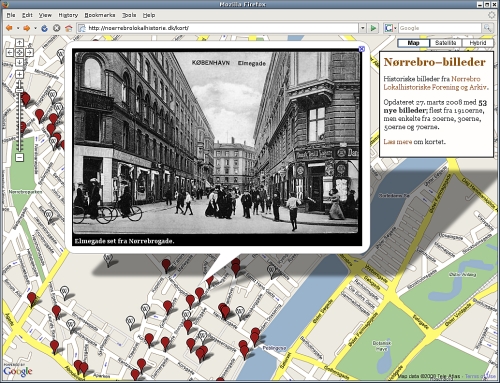
For my younger students, I have been trying to teach research skills, and this week, we maneuvered Google Maps to develop mapping skills – which is somewhat related to research. In our novel for class, the characters travel along the east coast of Denmark hitting three large cities in addition to Copenhagen. With the list of other cities, students had the following mission: locate the four cities on a map, calculate the total distance traveled by train from Copenhagen to the northernmost city, and draw a map of eastern Denmark and southwestern Sweden. (The proximity of Denmark to Sweden plays an integral role later in the novel.) What made the activity interesting was that all of the city names were in Danish (e.g., Copenhagen = Kobenhavn). Overall, it was a fun activity. Students enjoyed using Google Map and found it “cool” that you could add destinations to extend your route. I wonder how they would have responded to Google Earth.

-----

Image Citations:

YouTube. Retrieved on June 26, 2008, from http://www.erikbosgraaf.com/images/youtube-logo.png
Copenhagen. Retrieved on June 26, 2008, from http://noerrebrolokalhistorie.dk/img/histbillederkort01s.jpg